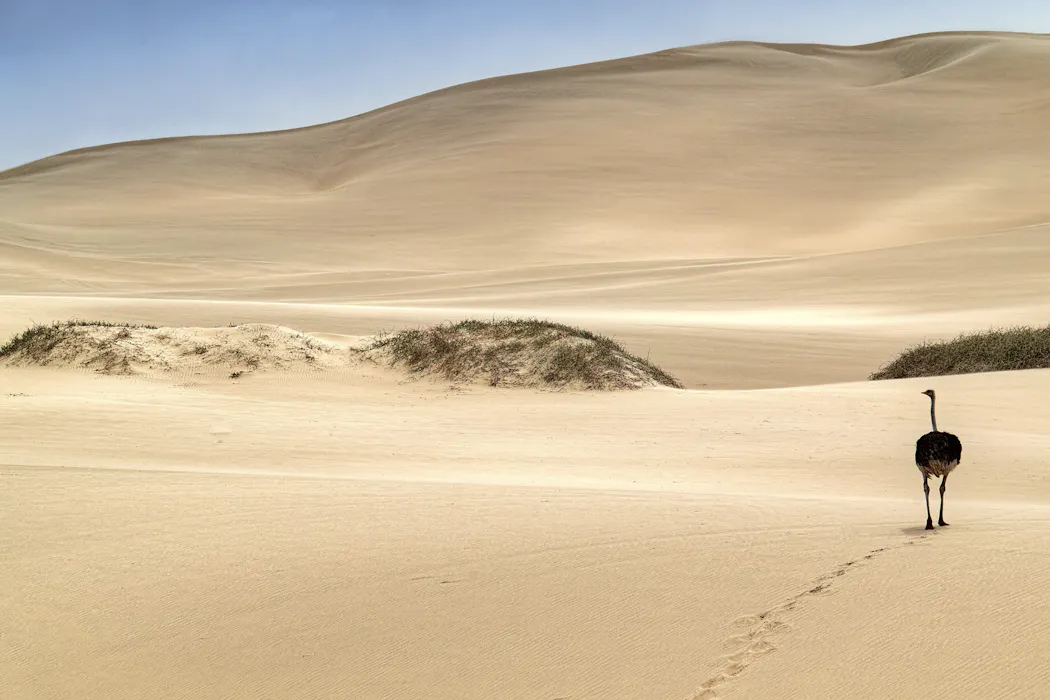
A study published in The Conversation Africa discusses how oxygen atoms found in 15-million-year-old giant eggshells from the Namib desert provide insights into how plants responded to a hotter Earth during the Miocene Epoch. The eggs, laid by extinct relatives of ostriches, serve as time capsules of ancient air, revealing climatic conditions of that era, which is considered an intermediate geological period between the age of dinosaurs and more recent times.
AI summary. Verify with the original source.
Read full story at The Conversation Africa ↗
Listen
Unlock audio summaries, audio summaries, AI chat, Wikipedia facts, and ad-free reading.
$3.99 / month · cancel anytime
Go PremiumBackground facts
Unlock wikipedia facts, audio summaries, AI chat, Wikipedia facts, and ad-free reading.
$3.99 / month · cancel anytime
Go PremiumSimilar stories

A new human ancestor, named Orrorin, has been identified from a limited collection of ancient bone fragments, which includes femur pieces, jaw fragments, isolated teeth, a partial upper-arm bone, and finger bones. This discovery sheds light on the evolutionary history of humans, although much of the information about the species is derived from these fragmentary remains.
Tanzania Times·July 2, 2026 at 11:44 AM
Climate prediction scientists announced in June 2026 that a super El Niño had formed, expected to be one of the strongest on record. This phenomenon occurs when the Pacific Ocean's surface warms unusually, impacting global weather patterns and potentially leading to extreme events like droughts and floods. In southern Africa, previous cycles have resulted in severe hot and dry conditions, affecting millions and threatening marine life such as seals and sea lions.
The Conversation Africa·July 5, 2026 at 2:48 PMEgypt has announced the discovery of a well-preserved Byzantine-era residential city in the western desert, along with another significant find at the Marina el-Alamein archaeological site near Alexandria. The discoveries include seven surface limestone-built tombs, as reported by the Ministry of Tourism and Antiquities.
AP Top News·July 4, 2026 at 2:23 PM
The demand for critical minerals such as lithium, vanadium, copper, and cobalt, driven by the global transition to green energy, has implications for deforestation in Africa. Sub-Saharan Africa contains about 30% of the world's mineral reserves, including significant amounts of platinum, chromium, manganese, and cobalt, much of which is located beneath biodiverse forests that play a crucial role in carbon capture and soil health, according to The Conversation Africa.
The Conversation Africa·June 29, 2026 at 2:22 PM
Eastern Angola, particularly the highlands of the Moxico provinces, has remained isolated and understudied despite its rich biodiversity and cultural history. The region's political history, including its independence from Portugal in 1975 and a subsequent 27-year civil war, has contributed to this isolation. The impact of these historical events has influenced local agricultural practices, particularly the use of controlled fires by farmers to manage dry fuel near villages.
The Conversation Africa·June 24, 2026 at 1:53 PM
Three Brazilian sisters, with a combined age of 316 years, have been acknowledged as the world's longest-living trio. They shared insights into their longevity and the secrets to a fulfilling life, although specific details of their discussions were not disclosed.
Al Jazeera·June 25, 2026 at 5:08 AM