
Tribune Online published an opinion piece titled 'Decolonising the map, decolonising the mind,' in which the author recalls being introduced to the world through maps as a child by a school teacher neighbour, Mr. Adegoke, who gave them an encyclopaedia filled with world maps. The piece appears to reflect on how maps shape perceptions of the world and calls for decolonising both cartography and mindsets.
AI summary. Verify with the original source.
Read full story at Tribune Online (NG) ↗
Listen
Unlock audio summaries, audio summaries, AI chat, Wikipedia facts, and ad-free reading.
$3.99 / month · cancel anytime
Go PremiumBackground facts
Unlock wikipedia facts, audio summaries, AI chat, Wikipedia facts, and ad-free reading.
$3.99 / month · cancel anytime
Go PremiumSimilar stories

The United Nations has adopted a new approach to world mapping after acknowledging that the Mercator projection, the most widely used map for 450 years, distorts Africa's true size, according to Al Jazeera. The change aims to correct longstanding cartographic bias that has made the continent appear smaller than it actually is, reflecting a broader push for more accurate global representation in education and international institutions.
Al Jazeera·September 8, 2026 at 11:07 PM
Premium Times reviews "Colours of My Mind," a book described as a record of how an engaged Nigerian citizen reflected on his country in real time from the vantage point of the Niger Delta. According to the review, the work's value lies less in comprehensive political analysis than in the immediacy of its observations, the force of its convictions, and its willingness to engage with Nigeria's challenges as they unfolded.
Premium Times·September 8, 2026 at 12:34 PM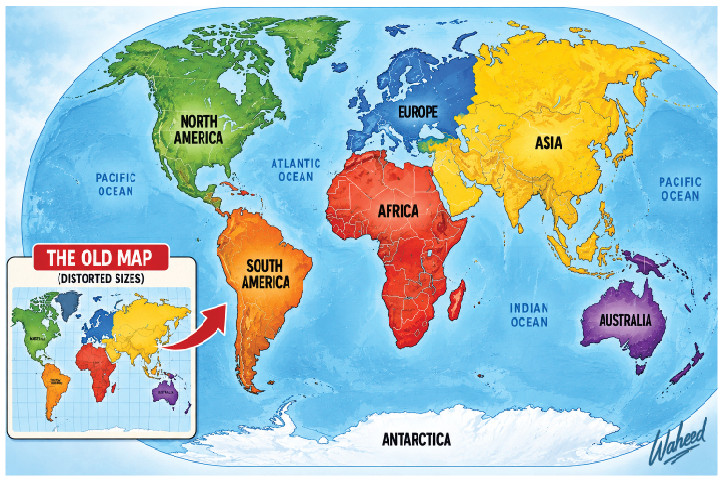
An opinion piece in Nigeria's Leadership newspaper argues that Africa's geographical size has been distorted for centuries by standard world maps, which make Greenland appear nearly as large as the continent even though Africa could contain the United States, China, India and much of Europe. The article references the United Nations General Assembly on September 4, 2026, in connection with efforts to correct this perceived minimisation of Africa's true scale.
Leadership (NG)·September 9, 2026 at 4:12 AM
A speaker identified as Ajulo has told the United Nations and other international audiences that Africa was never geographically small, arguing that the continent's diminished appearance stems from how it has been represented rather than any change in reality. "Africa did not change when that image became familiar. The representation did," he said, according to Tribune Online. The remarks, published by the Nigerian outlet, appear to challenge widely used world map depictions that critics say understate Africa's true size.
Tribune Online (NG)·September 9, 2026 at 4:37 PM
In an opinion piece for ThisDay Live, Kayode Ajulo reflects on the United Nations' recent move towards a more equitable representation of Africa, framing the decision as symbolically significant beyond its immediate subject. According to the author, the shift corrects a long-standing distortion in how the continent's true size and importance have been portrayed, carrying a broader meaning about Africa's place in the world.
ThisDay Live·September 8, 2026 at 8:36 PM
Ahmed Aminu-Ramatu Yusuf reflects on his time at Government Secondary School, Fadan Kaje, from 1975 to 1978, which was previously owned by Catholic missionaries and known as St. Joseph. He recalls Reverend Father John Haverty as the Principal and mentions that Catholic priests largely managed the school. Additionally, he notes that one of his teachers was Alhaji (Dr) Zubair Jibril, the current Emir of Birnin Gwari, Kaduna State.
Premium Times·July 4, 2026 at 4:55 PM